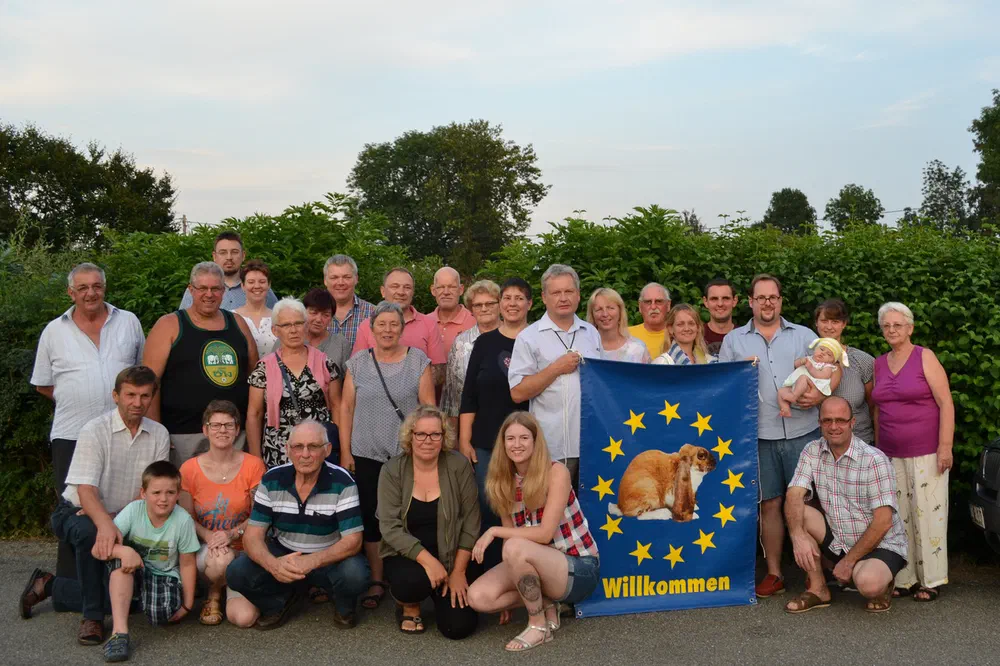
The annual gathering of the IG Englische Widder, the international English Lop interest group, took place from 3 to 5 August 2018 at Markus Tyborski’s in Bad Saulgau, Baden-Württemberg.
The meeting started on Friday afternoon with a pleasant walk through the town of Bad Saulgau. As the heat lasted into the evening and night that day too, the social evening was opened with cool drinks in the beer garden of the hotel “Oberamer Hof”. More participants arrived one after another, so we were already a large group on the first evening.
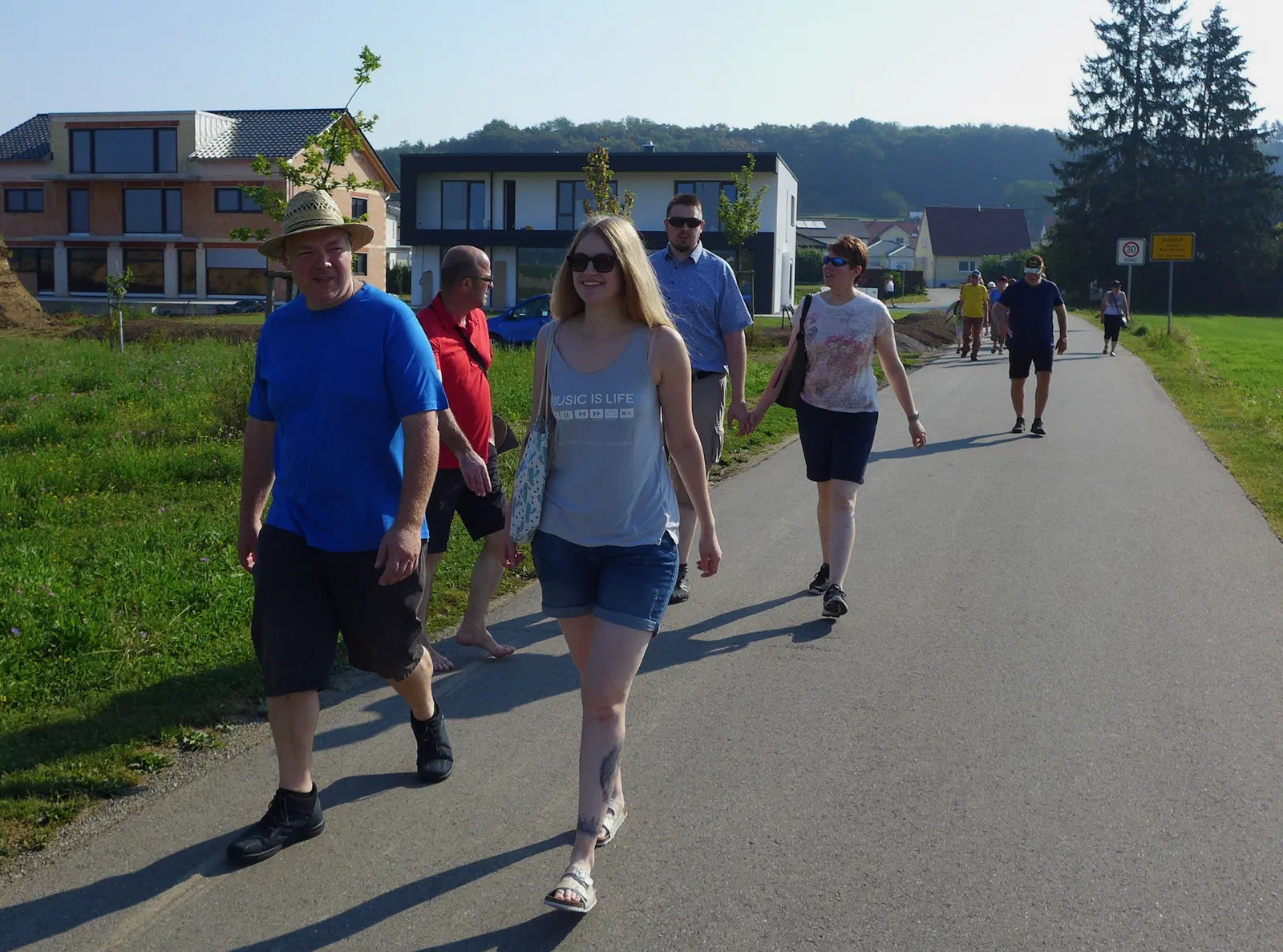
After a generous breakfast in the various hotels, we walked through the countryside in pleasant temperatures and the best of weather from the “Oberamer Hof” to our host’s rabbitry.
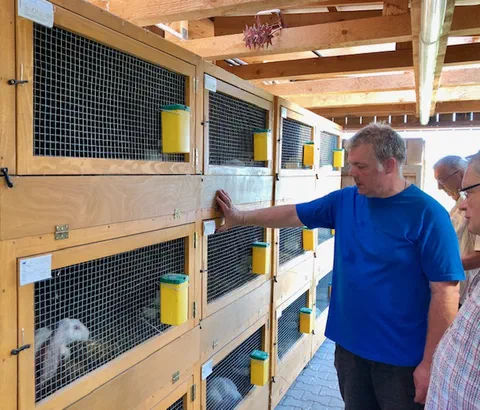
Some members and guests had already arrived earlier and inspected the superbly equipped rabbitry. The pen size of 0.95 m x 0.85 m is remarkable. Individual sections of the setup, which has 63 pens in total, can be moved on castors to protect the animals from draughts or direct sunlight. Thanks to the translucent roof, the English Lops have daylight all day long and are still protected from the rain.
Judges from the local Black Forest group had also been invited and came along (among them chairman Gerhard Zimmermann and training officer Franz Rettich) to find out about the latest state of affairs with this old Red List breed.
On the occasion of the “non-deletion” of the chinchilla colour variety, Claudia Gerst gave a very interesting and comprehensive talk. She has this special colour variety in her own rabbitry and therefore brought animals of different ages and of varying quality of colour and shading to the meeting. Using diagrams, pedigrees and the animals themselves, she explained how the colour variety has developed. Claudia also told us how she came by suitable foundation animals and which hurdles she had to overcome. In the end, it was only thanks to a cross-border exchange and Claudia’s persistence – paired with a lot of staying power – that the animals could be brought to Germany.
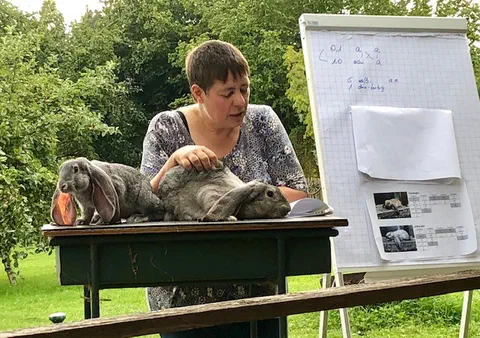
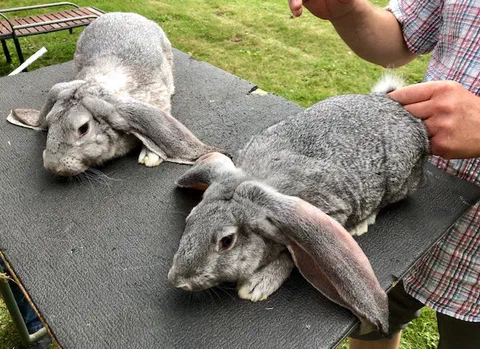
The animals shown made it very easy to see the different stages of the matings carried out and the areas where there are still shortcomings. The intermediate colour and undercolour, for example, are already quite appealing, but the required ear length is still a work in progress. However, as the colour variety is becoming increasingly popular within the IG, chinchilla English Lops will certainly be seen at one or other of the major shows in future.
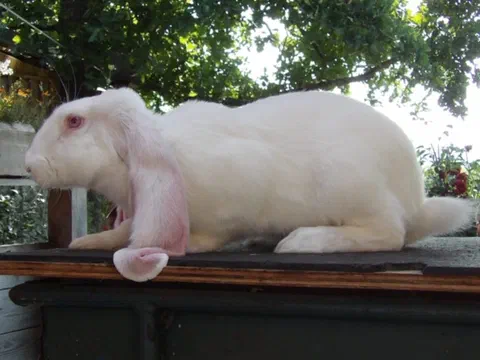
After the talk came the stock assessment. Fellow breeder Tyborski, who breeds the colour varieties red-eyed white, black and agouti as well as their broken versions, brought all kinds of animals to the table for assessment. The yellow colour variety, bred by his daughter, could also be examined, and so Franziska Sprenger led the stock assessment. Alongside animals with excellent mantle marking in black-and-white and agouti-and-white, there were also examples with serious faults (e.g. white spots on the nose) to assess.
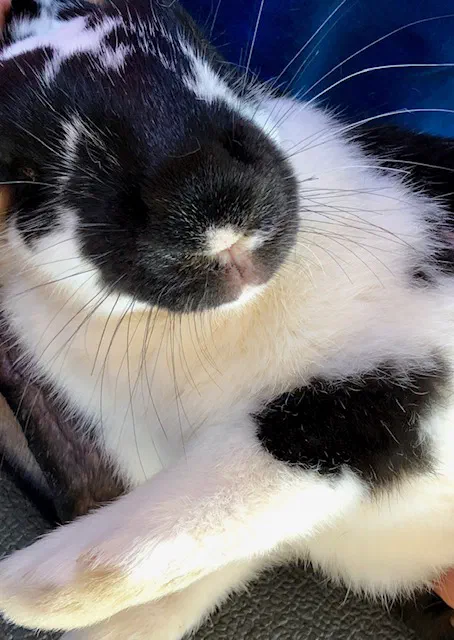
These animals are also very valuable for a stock assessment. The topic “Measuring the ears” was demonstrated once again, so that the judges present could also try it out and ask questions. After the already very promising youngsters, Markus also showed some of his adult animals in white and black-and-white. Here you could see the basis of the heavy, long types that we all appreciate in Markus’s breeding.
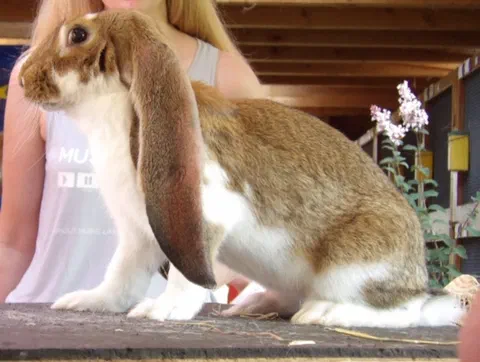
The Lehmann breeding partnership also brought a very fine example of the blue colour variety to the meeting, which impressed with a fine coat and a very nice, even back line.
Afterwards there was a lively exchange among the guests and judges.
After a hearty lunch, served by the small livestock breeders’ club Z142 Bad Saulgau, we set off back to the hotel.
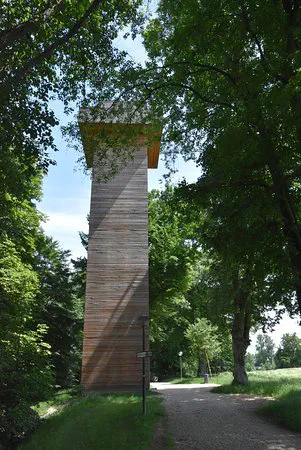
In the afternoon most of the group walked to the Kinzelmann Tower; the tireless ones climbed the countless steps to enjoy the view.
Afterwards we visited the adjacent spa gardens. It was well worth the walk: a small pond where you could have your feet tended by hungry fish in warm thermal water was a unique experience, lined with beautiful flower beds. Coffee, cake or ice cream at Café Schillergarten rounded off the hot afternoon of over 30 °C perfectly.
In the evening our annual general meeting took place in the club house in Bad Saulgau.
The 1st spokesperson, Phillip Fritz, welcomed all participants and announced the agenda.
In total, 16 members and 10 guests were present. The IG currently has 49 members.
Those present held a minute’s silence for the recently deceased (former) IG members Fritz Wiedmann and Wieland van der Ahe.
Franziska Sprenger read out the minutes of the last AGM in 2017 in Uhlstädt (Thuringia), which had been written by the then 3rd spokesperson, Hans-Günter Flath.
Phillip Fritz gave a short review of the past 2017 breeding and show season. The highlights were the European show, the lop club show (Widder CVS) and the German national show. Detailed accounts and pictures can be found in the last newsletter. The 4th newsletter was produced in a new design. It now also serves to recruit members and was produced in handy A5 format. The reason for the late delivery of the newsletter was the conference of the ZDRK, Germany’s national association of pedigree rabbit breeders, and of the DPV in June. The new German pedigree rabbit standard was presented at these events.
Frank Lettau, as 2nd spokesperson, presented the financial report for 2017. The IG closed the 2017 financial year on the reporting date of 31 December 2017 with a positive overall balance.
Franziska Sprenger, as 3rd spokesperson, gave a talk on the new German pedigree rabbit standard. It had been presented at the ZDRK and DPV conference in Niefern-Öschelbronn. She gave an insight into the new scoring scheme coming into force on 1 October 2018 and explained the redesign of the judging card.
For the English Lop, the points requested by the IG were not fully implemented. Neither the finer points on the head profile nor the note on the “hairdo” were adopted. However, in position 4 (ear length) the method of measuring was spelled out and the requested division of ear length into centimetre bands was made specific. This means it is now clearly graded from which measurement points are to be awarded. The centimetre bands were also implemented in position 5 (ear width).
There is also news on colour (position 6): havana English Lops are once again listed among the permitted colours, contrary to the 2016 list of breeds and colour varieties to be deleted. From 1 October 2018 they can therefore be shown and judged again. Our broken English Lops are no longer assigned to the broken German Lop (as the breed of origin) but to the Mecklenburger Schecke breed. This means the minor and major faults of the head and body markings of the Mecklenburger Schecke now apply. This will certainly please one or other breeder of mantle-marked English Lops.
René Karpf gave his report as the international representative of Switzerland. The lop breeders of eastern and western Switzerland have been merged and are now run as one association. Unfortunately, the new successor as head of the lop club, Roger Brossard, is no longer an IG member, which is very disappointing. René Karpf once again voiced his concerns about the new standard. He criticised the fact that each country uses its own standard and that there is no uniformity.
Following the resignation of the 2nd spokesperson, a new election had to be held.
Franziska Sprenger proposed Claudia Gerst for the election. Those present and entitled to vote unanimously elected Claudia Gerst as 2nd spokesperson of the IG.
Phillip Fritz thanked Markus Tyborski for hosting the 30th meeting and presented him with the IG coat of arms and flowers.
In future, the annual young stock census list will be compiled with 31 May as the reporting date. Franziska Sprenger will send the list to members by email about 1 week before the reporting date and include the information gained in the newsletter. This way, members will have an overview even before the AGM and can, if need be, get in touch with each other, for example to ask other members for individual animals of rare colours and bring them together into breeding populations.
Our IG, too, has to implement the rules on storing and protecting members’ personal data correctly. For this purpose, a document drawn up specially for it was sent to every member.
After a convivial evening, the IG closed the official part of the annual meeting. Sunday was free and was mostly used for the journey home.
I look forward to seeing you again in July in Bonn.
Kind breeder’s regards
Franziska Sprenger, 3rd spokesperson